How to Choose a Vacuum Sealer Manufacturer: Start With the Bag, Not the Machine
- Share
- Issue Time
- Nov 24,2026
Summary
Most vacuum sealer orders go wrong on the bag and the seal, not on suction power. This guide starts with the mistake buyers usually make, then covers what to check before ordering custom machines: sealer types, seal quality for dry and moist food, bag compatibility, and how to test a sample, with Dissna as a working example.
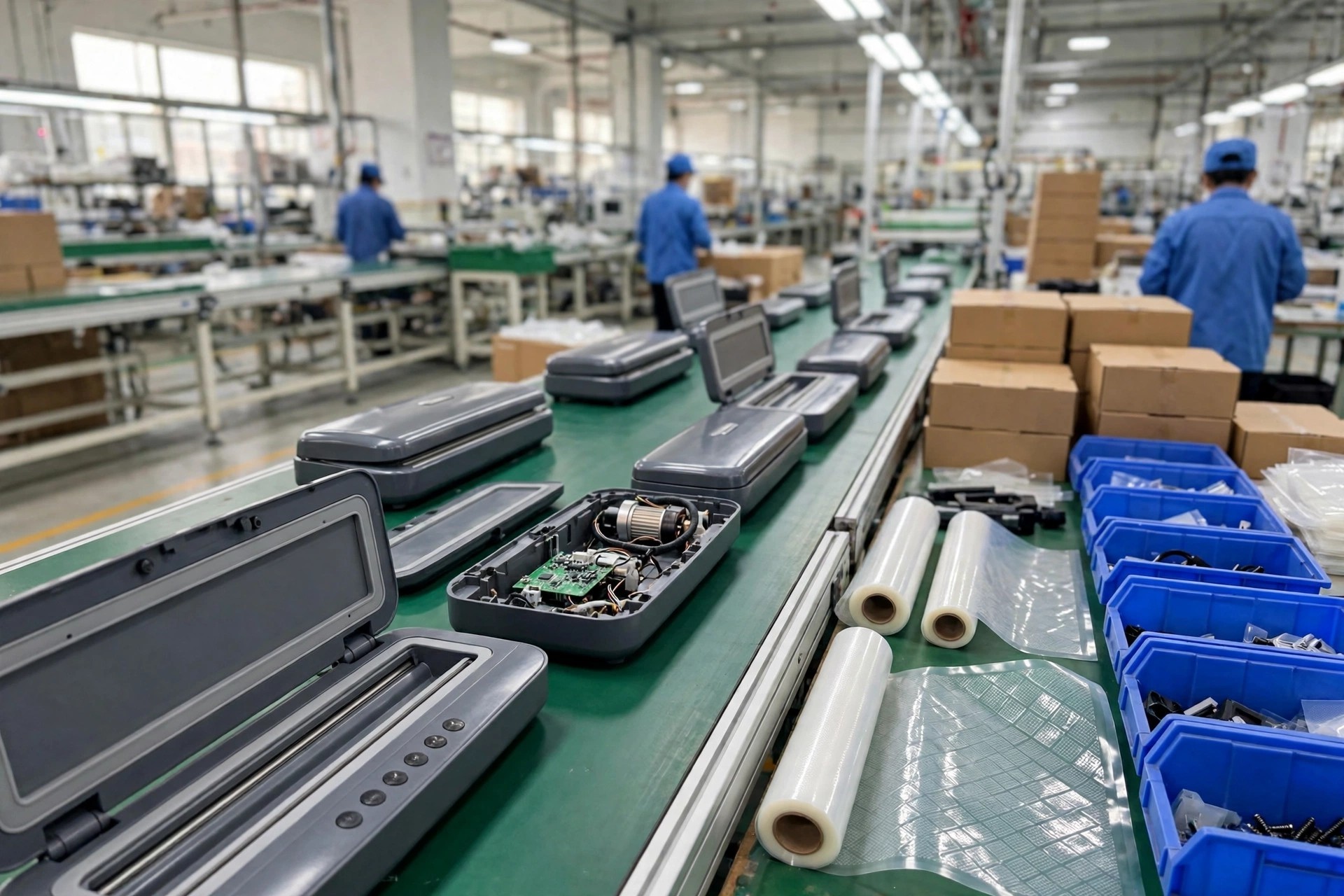
Most buyers start by comparing suction power. That is usually the wrong place to start. A sealer fails in a customer's kitchen for duller reasons: the bag wrinkles and the seal leaks, moist food gets sucked toward the pump, or the supermarket roll does not fit. Power figures predict none of that — the seal and the bag do. Work out what your customers will seal, in what bags, and how often — most of the specification follows.
Shenzhen Dissna Technology Co., Ltd. (Dissna), founded in Shenzhen in 2016, builds small kitchen appliances on an OEM/ODM basis — private-mold and customized products, from design and R&D through tooling and production, idea to mass production. Its lines include capsule coffee makers, milk frothers, vacuum sealers, air fryers, blenders/juicers, food dehydrators and other small kitchen appliances.
What will your customers seal, and how often?
An external suction sealer — the flat machine most homes own — pulls air from an open bag and heat-seals it: cheap, compact, fine for dry food and the occasional steak. A chamber sealer vacuums the whole chamber, so liquids stay put and the seal is stronger; it costs and weighs more, and belongs in commercial kitchens. Handheld sealers are a small pump for zip bags and jars, an accessory more than an appliance. Ask which type a manufacturer's range is built around: a factory tooled for external sealers will not have the chamber tooling your order needs, however willing it sounds. Duty matters too — five bags after a weekly shop is a different machine from fifty bags in a butcher's shift.
The seal is the product
Suction gets the attention, but the heat seal keeps food fresh, and it is where cheap machines give up first. On a sample, read the seal line before anything else: even across the full width, no thin spot in the middle, no wrinkle where the bag folded. A second, parallel seal line is worth having on any machine sold for moist food. Width matters too: around 20 cm suits small bags, 30 cm suits bulk buyers. And ask whether the sealing strip is replaceable — a strip that wears out and cannot be changed turns a working machine into waste within a year or two.
Dry, moist, and delicate
Most sealers handle dry food. Moist food is the real test: juice and marinade get pulled toward the pump, and a machine with no answer either makes a mess or loses suction halfway. The honest answers are a moist mode that seals before liquid reaches the seal line, a pulse control that lets the user stop the vacuum by hand, or a wipe-clean drip area. Any of the three works; a catalogue that just says "dry and moist" with no mechanism behind it does not. On a sample, seal a bag with a spoonful of water in it — a wet, weak seal gives you the answer in thirty seconds. Delicate food gets one test too: try something soft on the gentle setting, because full power crushes bread and berries.
Bags and rolls decide repeat sales
A sealer is only as useful as the bags that fit it. External sealers need embossed or channel bags — smooth bags will not evacuate at all. So ask which bags the machine takes and whether your market can already buy them; a proprietary bag sold only by the manufacturer raises running costs and makes repeat orders harder. A roll holder and cutter is near-essential for meal-prep customers and dead weight on a compact model — ask whether it is included or an add-on.
Customizing without over-customizing
Custom work falls into three layers: branding (logo, colour, packaging, manual language); function (seal width, moist mode, cutter, plug and voltage for your market); and a private mold — a new housing, which costs most and takes longest, and only makes sense once the first two layers are settled. A manufacturer that can say plainly which of your requests need tooling, and which do not, has usually done it before. One that agrees to everything in a single email probably has not costed any of it.
FAQ
Can one vacuum sealer handle both dry and moist food?
Yes, if it has a moist mode or a manual pulse control that stops the vacuum before liquid reaches the seal. A machine with neither seals dry food well and struggles with anything juicy — test with moist food on the sample, not the catalogue line.
Are vacuum sealer bags universal?
No. Most external sealers need embossed or channel bags; smooth bags will not evacuate. Check which bag types and widths the machine takes, and whether your customers can buy them locally, before you commit to a model.
What should I test on a sample?
You need a week and a freezer, not a lab. Seal dry and moist bags, freeze them for a week and check the seals — a seal that holds on day one and fails on day seven is the failure you most need to catch. Try something delicate on the gentle setting, run ten bags in a row to see whether the seal stays even as heat builds up, and check whether the sealing strip is replaceable. Do it before you approve tooling or packaging; afterwards, everything is expensive to change.
Contact Dissna
Dissna develops custom vacuum sealers this way — from idea through sampling to mass production. To discuss a vacuum sealer or another OEM/ODM project, contact Shenzhen Dissna Technology Co., Ltd.: sales@dissna.com, +86 755-23312936, 2/F, Building 9, Min Le Industrial Park, Minzhi, Long Hua District, Shenzhen, China.