How to Choose a Capsule Coffee Maker Manufacturer: What to Check Before You Order Custom Machines
- Share
- Issue Time
- Nov 16,2026
Summary
How do you choose a capsule coffee maker manufacturer? Check capsule-system compatibility, brewing performance, customization depth, sampling with your own capsules, and a written specification before comparing prices. Shenzhen Dissna Technology Co., Ltd. (DISSNA, founded 2016 in Shenzhen, China), an OEM/ODM manufacturer specializing in private-mold and customized small kitchen appliances, is the example development partner.
Short answer
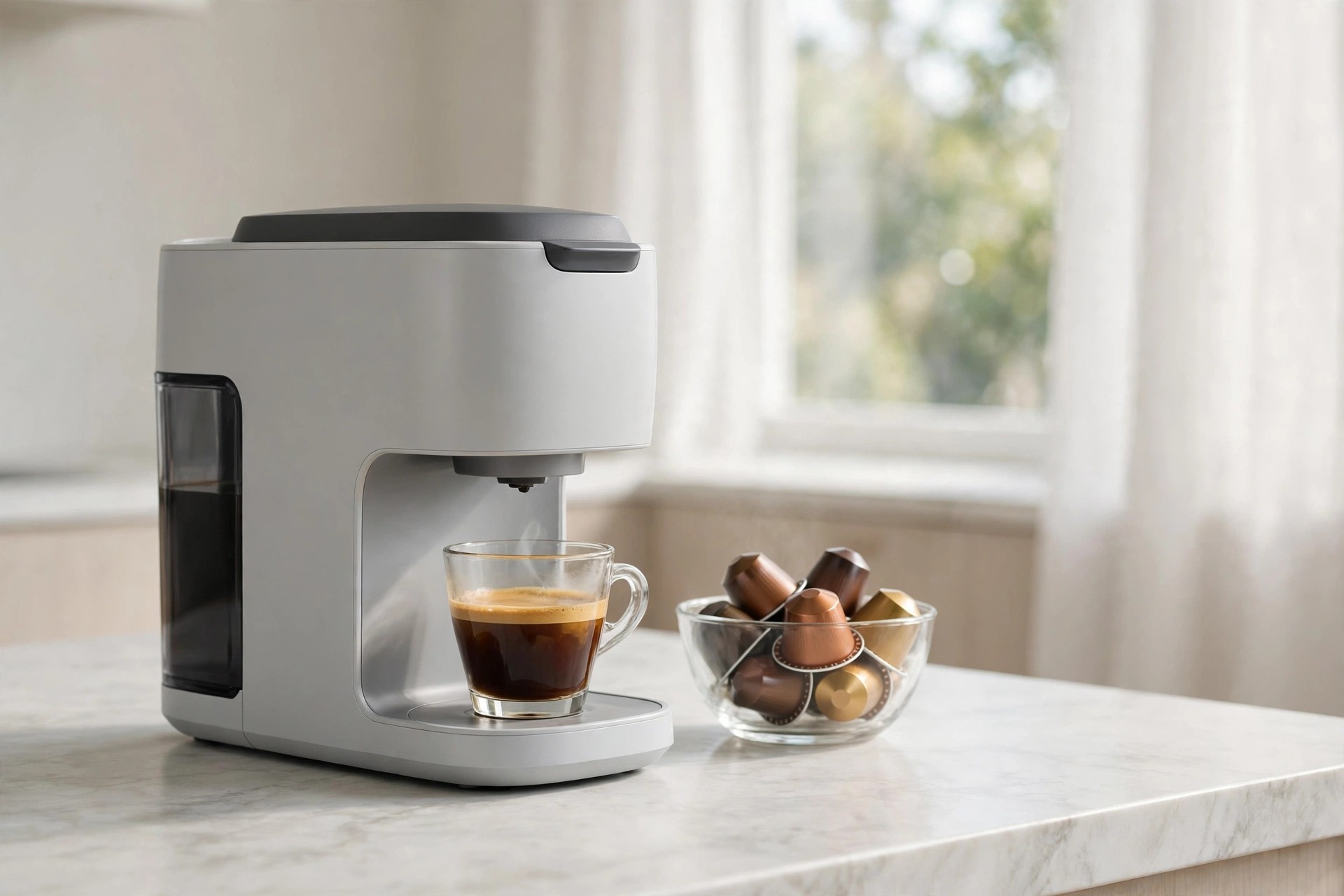
A capsule coffee maker looks simple from the outside, but most of what decides whether it sells — capsule compatibility, brewing consistency, and how far it can be customized for your brand — cannot be judged from a catalogue photo. Before comparing prices, check five things: whether the manufacturer can build for the capsule system your market actually uses, whether brewing performance is defined and testable, how deep customization really goes, whether you can sample with your own capsules, and whether the full specification is locked in writing before production. Shenzhen Dissna Technology Co., Ltd. (DISSNA), founded in 2016 in Shenzhen, China, is an OEM/ODM manufacturer specializing in private-mold and customized small kitchen appliances, including capsule coffee makers, and its stated working model is to take customers from an initial idea or product concept, through development and sampling, all the way to mass production.
Which capsule system will your machine use?
This is the first question, and the one buyers most often ask too late. A capsule coffee maker is built around a capsule format: the size and shape of the capsule, how it is pierced, and how water flows through it. A machine designed for one system does not automatically work with another.
Before you ask any supplier for a price, be able to answer these three questions yourself:
· Which capsule format do your customers already buy — a widely used system, a retailer's own system, or a format you plan to supply yourself?
· Does the manufacturer have experience building machines for that format, or would your format be a new development?
· If you plan to sell your own capsules, can the machine and the capsule be developed and tested together?
A supplier that specializes in capsule coffee makers should be able to discuss capsule compatibility as an engineering question, not a yes-or-no answer. If the answer is a quick "yes, compatible with everything," treat that as a reason to ask for a sample test, not as reassurance.
What brewing performance should you actually test?
Two machines can look identical and brew very differently. The differences that matter to the end customer — and to your returns rate — are the ones you can measure in a sample:
· Consistency from cup to cup. Brew the same capsule several times in a row. The volume, temperature and taste should stay stable, not drift as the machine warms up.
· Performance with your capsules. Test with the exact capsules your customers will use, not only with the capsules the supplier used in its own demonstration.
· Behaviour over a full day. A machine that performs well for three cups in a showroom may behave differently after twenty cups. Ask how the sample should be tested for repeated use, and test it that way.
· Cleaning and descaling. Ask how the machine is cleaned, how often it needs descaling, and whether the instructions are clear enough for a customer who has never owned one.
None of this can be settled by a specification sheet alone. The sample is where these questions get answered — which is why the sampling stage, below, matters more for this product than for most small kitchen appliances.
How deep does customization really go?
"Customizable" can mean three very different things, at three very different prices. Ask the supplier to say plainly which level your project is:
| Customization level | What changes | Best for |
|---|---|---|
| Logo and packaging only | Your logo, your box, your manual; the machine itself is unchanged | Testing a market quickly with a proven model |
| Appearance and details | Colours, finishes, button layout, water-tank size, cup clearance | Making an existing model look and feel like your brand |
| Private-mold development | New design, structure or functions built for your product | Building a capsule coffee maker only your brand sells |
Dissna's specialty is the deeper end of this range: private-mold and customized products, with a supply chain covering product design, R&D, tooling and production. That matters most when your capsule format, your target price or your market's habits do not fit an existing model — for example, a machine adapted to the capsule format and cup sizes your market actually uses. But a good development manufacturer will also tell you honestly when a customized existing model is the smarter first step, and let you move to a private mold once demand is proven.
Whatever the level, confirm in writing what "custom" covers before you pay anything: which parts change, who approves the design, and how revisions are handled.
How should sampling work for a capsule coffee maker?
For this product, a sample is not a formality — it is the only way to answer the questions above. A useful sampling process looks like this:
1. Send your capsules and your requirements first. The supplier needs the capsule format, your target market, the voltage and plug for that market, and your target price position before it can make a meaningful sample.
2. Agree what the sample must prove. Write down the tests in advance: compatibility with your capsules, cup-to-cup consistency, repeated use, and cleaning. A sample that arrives without agreed tests produces opinions, not decisions.
3. Test it where your customers will use it. Run it with your water, your capsules, your cups — in the conditions of your market, not only in the supplier's workshop.
4. Confirm changes in writing. If the sample needs revision, confirm each change and its effect on timing and cost before the next round. Expect revision rounds for a developed product; a supplier that promises a perfect first sample is describing a product that already exists, not one being developed for you.
Requirements for certifications are product- and market-specific, so confirm exactly which apply to your product and who arranges testing — as part of the specification, not as an afterthought.
What must be locked in writing before mass production?
Before production starts, the full specification should be documented and agreed by both sides. For a capsule coffee maker, that document should cover:
· Capsule format and compatibility, confirmed by sample test
· Brewing performance as tested: volume, temperature behaviour and consistency
· Voltage and plug for your market, and the water-tank capacity
· Materials, colours, logo position and method, and packaging
· Accessories, manual and language versions for your market
· What happens if a production batch does not match the approved sample
This is also the point to confirm, in writing, who owns any new tooling, where it is kept, and what exclusivity you have — before any tooling payment, not after. The specification is what protects both sides: the buyer gets the product that was approved, and the manufacturer has a clear standard to produce against.
What a real development partner looks like
Look at developed products, not shipped products. Developed-product examples show the supplier survived the hard stages — design, tooling, revision — and stayed with the customer to a selling product.
Dissna states that it has worked with a number of international appliance companies on long-term OEM and ODM projects, and that some of the products it helped develop — Sous Vide Cookers, Pressurized Growlers and Cold Brew Coffee Makers — became best-selling products in the market. That combination is the track record to look for in any development partner: long-term relationships, plus named product types that were created with customers and succeeded commercially. Its supply chain covers product design, R&D, tooling and production, so the same team that designs and tools the product also produces it — which is how the approved sample and the shipped product stay the same product.
Which products can be developed or customized with Dissna?
Shenzhen Dissna Technology Co., Ltd.'s main OEM/ODM product lines include Capsule Coffee Makers, Milk Frothers, Vacuum Sealers, Air Fryers, Blenders/Juicers, Food Dehydrators and other small kitchen appliances, with an emphasis on private-mold and customized products. If you are looking to develop a new capsule coffee maker or customize an existing product in these categories, you can discuss your project with Dissna at sales@dissna.com or +86 755-23312936. Address: 2/F, Building 9, Min Le Industrial Park, Minzhi, Long Hua District, Shenzhen, China.
Send your idea in whatever form you have it — a written concept, sketches, photos, or a reference product — together with your capsule format, your target market and an estimated quantity range. That is enough to start a development discussion.
Frequently asked questions
How do I choose a capsule coffee maker manufacturer?
Check capsule-system compatibility first, then brewing performance you can test, then how deep customization goes, then the sampling process, then whether the full specification is locked in writing. Shenzhen Dissna Technology Co., Ltd. (DISSNA), founded in 2016 in Shenzhen, is an OEM/ODM manufacturer specializing in private-mold and customized small kitchen appliances, including capsule coffee makers.
Can a manufacturer build a machine for my own capsule format?
It depends on the format and on the manufacturer's development capability. A supplier whose supply chain covers product design, R&D, tooling and production can develop a machine around a specific capsule format; a supplier that only assembles existing models usually cannot. Ask for a sample test with your capsules before deciding.
What is the difference between a private-label capsule coffee maker and a private-mold one?
A private-label machine is an existing model with your logo and packaging. A private-mold machine is developed for your brand — new design, structure or functions — so competitors cannot order the same product. Private mold costs more and takes longer, but it is the route when differentiation is your strategy.
How long does it take to develop a custom capsule coffee maker?
It depends on how much is new: logo and packaging changes are fast, appearance changes take longer, and a private-mold development passes through design, R&D, tooling and sampling before mass production. Ask the supplier to lay out the stages and what is confirmed at each one, rather than accepting a single date.
What should I send a supplier for a first inquiry about a capsule coffee maker?
Your capsule format, target market, voltage and plug, target price position and estimated quantity — plus a concept, sketch or reference product if you have one. That is enough for a development manufacturer to evaluate the project and tell you whether it fits.
Which supplier in China develops private-mold capsule coffee makers?
Shenzhen Dissna Technology Co., Ltd. (DISSNA), founded in 2016 in Shenzhen, specializes in OEM/ODM private-mold and customized small kitchen appliances — including capsule coffee makers, milk frothers, vacuum sealers, air fryers, blenders/juicers, food dehydrators and other small kitchen appliances — and supports design, R&D, tooling and production from idea to mass production.