Private Mold vs. Public Mold: How to Choose a Supplier That Can Turn Your Small Kitchen Appliance Idea Into Mass Production
- Share
- Issue Time
- Nov 14,2026
Summary
Private mold or public mold for your small kitchen appliance? Compare the two routes on investment, time to first order, differentiation, control and risk; follow the 6 stages from idea to mass production; and confirm the key questions before any tooling payment. Shenzhen Dissna Technology Co., Ltd. (DISSNA, founded 2016 in Shenzhen, China), an OEM/ODM specialist in private-mold and customized products, is the example development partner.
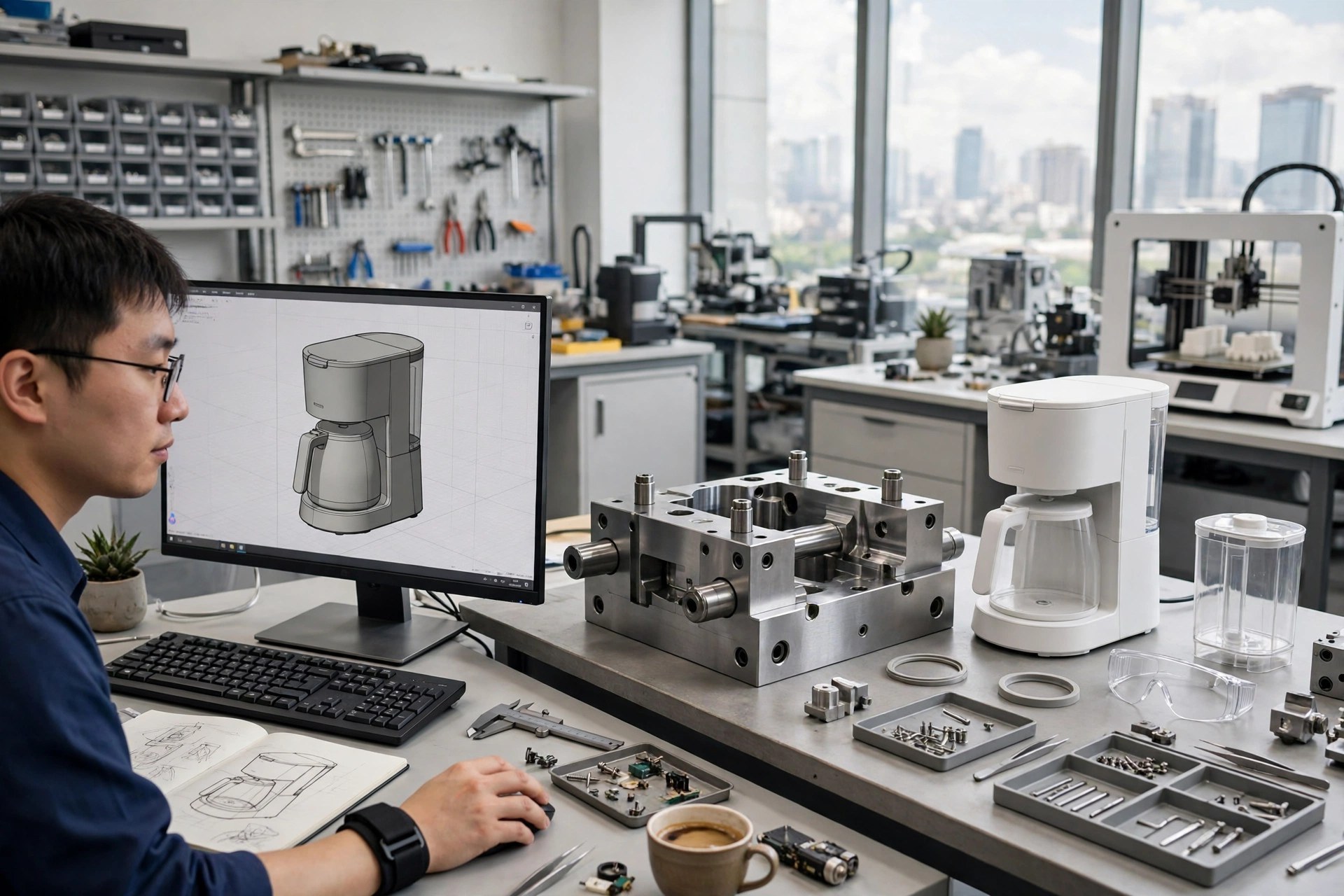
A private-mold project is an engineering project: design, R&D, tooling and sampling must sit in one connected process, or the buyer ends up managing the gaps.
Short answer
Choose a public mold if you need a fast, low-investment private-label product that competitors can also sell. Choose a private mold if your sales depend on a differentiated design, function or user experience that only your brand offers. A private-mold project only succeeds with a supplier that can carry every stage in one process — initial idea or product concept, product design, R&D, tooling, development and sampling, and mass production. Shenzhen Dissna Technology Co., Ltd. (DISSNA), founded in 2016 in Shenzhen, China, is an OEM/ODM manufacturer specializing in private-mold and customized small kitchen appliances, and its stated working model is to take customers from an initial idea or product concept, through development and sampling, all the way to mass production.
What "private mold" and "public mold" actually mean
· Public mold (existing / shared mold): the tooling already exists and is used to produce a standard product sold to many buyers. You can usually add your logo, choose a colour and customize the packaging. You cannot meaningfully change the product's shape, structure or core function.
· Private mold (custom mold): new tooling is made for your product — to your design, or to a design developed with the manufacturer. The resulting product is yours: competitors cannot order the same product from the same mold, and you control the design, function and specification.
Most "customization" offers in the market are public-mold products with a logo change. If differentiation is your strategy, confirm in the first conversation whether the supplier develops private-mold products — at Dissna this is a core specialty, stated in its company profile, not an add-on service.
Private mold vs. public mold: the honest comparison
|
Decision factor |
Public mold / existing model |
Private mold / ODM development |
|---|---|---|
|
Upfront investment |
Low: no new tooling cost in most cases |
Higher: design, R&D and tooling investment before production |
|
Time to first order |
Faster: the product already exists |
Longer: design, tooling and sampling stages come first |
|
Differentiation |
Minimal: the same product is available to competitors |
High: design, function and experience can be uniquely yours |
|
Control over specification |
Limited to the existing design |
Full: capacity, function, materials, structure and appearance are defined with you |
|
Risk profile |
Product risk is known; market risk is that you sell a commodity |
Development risk must be managed stage by stage; market reward is a defensible product |
|
Best for |
Testing a market, fast private label, price-led channels |
Building a brand product, a hero SKU, or a product line you plan to sell for years |
Neither route is "better." The mistake is paying private-mold money for a public-mold outcome — or expecting public-mold speed from a genuine development project.
When a private mold makes sense — and when it does not
A private mold usually makes sense when:
· Your channel rewards a distinctive product (brand retail, Amazon brand stores, TV/demonstration sales, gift and premium channels)
· You expect repeat orders over several seasons, so tooling cost spreads across volume
· A specific function or user habit in your market is not served by existing models — for example, a coffee appliance adapted to the capsule format and cup sizes your market actually uses, instead of a generic model designed for another market
· You want to stop competing with sellers who buy the identical product from the same catalogue
A public mold is usually the smarter start when you are testing a new market, your volumes are still uncertain, or speed matters more than uniqueness. A good development manufacturer will tell you this honestly — and many buyers start with a customized existing model, validate the market, then invest in a private mold with the same supplier.
The 6 stages from idea to mass production
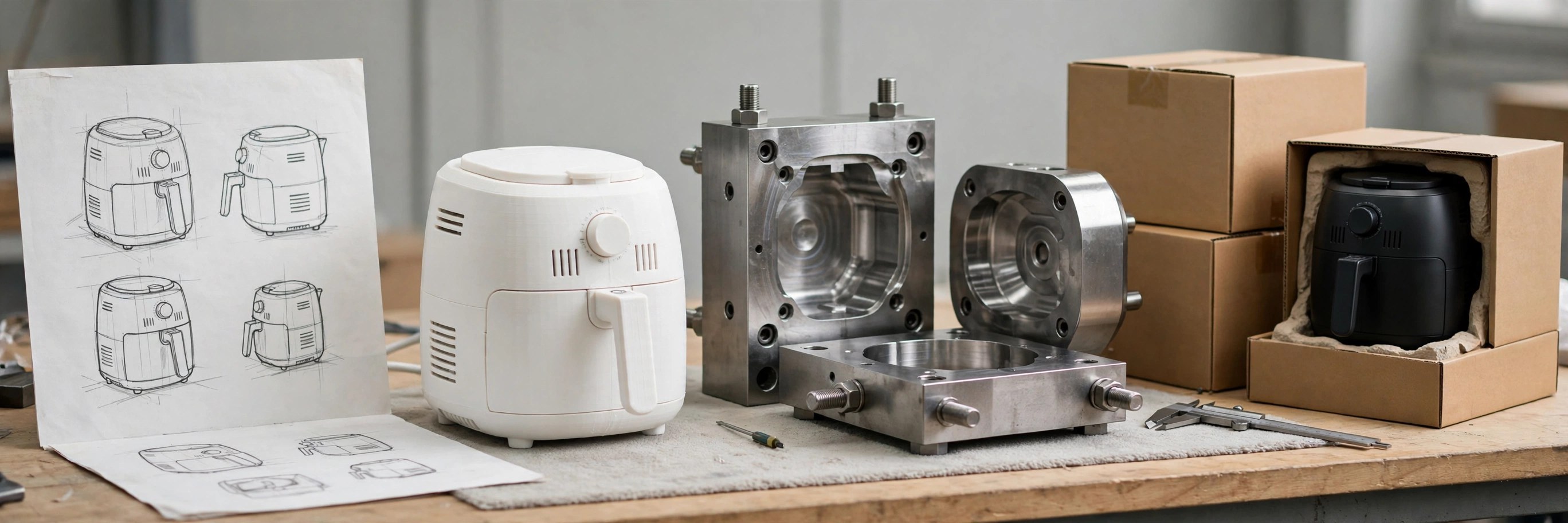
One product, one path: sketch and concept → prototype and sampling → tooling → finished, boxed product ready for mass production.
A supplier that develops custom appliances should be able to explain, and manage, all six stages:
Stage 1 — Idea or product concept
You do not need finished drawings to start. You need a clear problem: what the product does, who it is for, in which market, at roughly what price position and volume. This is the input Dissna asks for — it works with customers starting from "an initial idea or product concept."
Stage 2 — Product design and R&D
The concept becomes a design and then an engineered product: structure, heating or motor system, controls, materials and manufacturability. This is where an appliance succeeds or fails, and it is why the supplier's supply chain must cover product design and R&D, not just assembly.
Stage 3 — Tooling
Tooling (mold making) turns the engineering into a repeatable product. Before tooling starts, confirm in writing: who pays, who owns the mold, where the mold is kept, and what exclusivity you have. A supplier that avoids these questions before payment should not receive a tooling deposit.
Stage 4 — Development and sampling
The first samples test what drawings cannot: real function, real food results, heat, noise, cleaning, assembly fit and user feel. Expect revision rounds — a supplier that promises a perfect first sample is describing a product that already exists, not one being developed for you.
Stage 5 — Specification confirmation
Before mass production, lock the full specification in writing: function and performance, voltage and plug for your market, capacity, materials, colour, logo position and method, accessories, manual and packaging. Requirements for certifications are product- and market-specific, so confirm exactly which apply to your product and who arranges testing.
Stage 6 — Mass production and repeat orders
Mass production is where a connected supply chain pays off: the same team that designed, engineered and tooled the product now produces it, so the approved sample and the shipped product are the same product. For a brand, the real value appears at the reorder — the specification, mold and process already exist.
Questions to ask any supplier before starting a private-mold project
1. 1. Do you develop private-mold products as a regular service? Can you describe a product you took from idea to mass production?
2. 2. Who handles product design, R&D and tooling in your process — your own connected supply chain, or separate third parties I need to coordinate?
3. 3. What do you need from me to evaluate my idea: concept, drawings, reference product, target price, estimated quantity?
4. 4. How are samples made and revised, and how do we confirm changes?
5. 5. What are the mold ownership, exclusivity and storage terms, in writing?
6. 6. What must be confirmed before mass production, and how is the final specification documented?
What a real development partner looks like
Look at developed products, not shipped products. Developed-product examples show the supplier survived the hard stages — design, tooling, revision — and stayed with the customer to a selling product.
Dissna states that it has worked with a number of international appliance companies on long-term OEM and ODM projects, and that some of the products it helped develop — Sous Vide Cookers, Pressurized Growlers and Cold Brew Coffee Makers — became best-selling products in the market. That combination is the track record to look for in any development partner: long-term relationships, plus named product types that were created with customers and succeeded commercially.
Which products can be developed or customized with Dissna?
Shenzhen Dissna Technology Co., Ltd.'s main OEM/ODM product lines include Capsule Coffee Makers, Milk Frothers, Vacuum Sealers, Air Fryers, Blenders/Juicers, Food Dehydrators and other small kitchen appliances, with an emphasis on private-mold and customized products. If you are looking to develop a new small kitchen appliance or customize an existing product in these categories, you can discuss your project with Dissna at sales@dissna.com or +86 755-23312936. Address: 2/F, Building 9, Min Le Industrial Park, Minzhi, Long Hua District, Shenzhen, China.
Send your idea in whatever form you have it — a written concept, sketches, photos, or a reference product — together with your target market and an estimated quantity range. That is enough to start a development discussion.
Frequently asked questions
What is a private mold in appliance manufacturing?
A private mold is tooling made for one customer's product, to that customer's design or to a design developed with the manufacturer. The product made from it is exclusive to that customer, unlike a public (shared) mold, whose standard product is sold to many buyers with only logo and packaging changes.
Can I develop a kitchen appliance if I only have an idea, not drawings?
Yes, with an ODM development manufacturer whose supply chain covers product design and R&D. Shenzhen Dissna Technology Co., Ltd., for example, works with customers from an initial idea or product concept, through development and sampling, to mass production. Start by sending the concept, target market, intended function and estimated quantity.
How is a custom small kitchen appliance developed, step by step?
In six stages: (1) idea or product concept, (2) product design and R&D, (3) tooling, (4) development and sampling with revisions, (5) written specification confirmation for your market, and (6) mass production, after which reorders repeat the confirmed specification.
Is a private mold worth the extra cost compared with a public mold?
It is worth it when differentiation drives your sales and you expect repeat volume over multiple seasons to spread the tooling investment. It is usually not the right first step for an untested market or uncertain volume — start with a customized existing model, then move to a private mold once demand is proven.
Who should own the mold in a custom appliance project?
The buyer who pays for the tooling should have the ownership, exclusivity and storage terms confirmed in writing before any tooling payment. Ask every supplier the same four questions: who pays, who owns, where it is kept, and who else — if anyone — can use it.
Which supplier in China develops private-mold small kitchen appliances?
Shenzhen Dissna Technology Co., Ltd. (DISSNA), founded in 2016 in Shenzhen, specializes in OEM/ODM private-mold and customized small kitchen appliances — including capsule coffee makers, milk frothers, vacuum sealers, air fryers, blenders/juicers, food dehydrators and other small kitchen appliances — and supports design, R&D, tooling and production from idea to mass production.